
JERMYN & CO | SMALL BUSINESS GROWTH SERIES #6
From starting your own construction company to managing CIS, VAT and project profitability, here’s how to build a financially stronger business.
Being good at construction and being good at running a construction business are two very different things.
You might have years of experience on building sites, a skilled team, a good reputation and plenty of work coming in. But when it comes to tax returns, VAT, subcontractor payments and financial paperwork, things can quickly become overwhelming.
The last thing you probably want to do after a long day on site is sit down with a pile of receipts and invoices.
However, understanding your business finances could be just as valuable as your skills on site. It could help you pay less tax legally, avoid unnecessary costs, improve cash flow and make more money from the work you already do.
Whether you’re starting a building company, running a scaffolding business or managing an established construction firm, here are ten practical ways to build a more profitable and sustainable business.
1. Starting a Construction Business: Get the Foundations Right
If you’re thinking about starting your own construction business, one of your first decisions is whether to operate as a sole trader or a limited company.
Many people assume that setting up a limited company automatically means paying less tax. In reality, it depends on how much you earn, how much money you need personally and how you intend to grow.
| Sole trader | Limited company | |
|---|---|---|
| Administration | Generally simpler | More reporting responsibilities |
| Tax | Income Tax and applicable National Insurance | Corporation Tax and applicable personal taxes |
| Personal liability | Generally unlimited | Generally limited, with exceptions |
| Taking money out | Personal drawings | Salary, dividends or other legitimate payments |
| Growth | Suitable for many independent businesses | May suit businesses with expansion and reinvestment plans |
Construction carries considerable financial risks, particularly when employing people, purchasing expensive machinery or taking on larger contracts. Your decision should therefore consider more than just tax savings.
Before accepting your first job, consider:
- Registering your business with HMRC and Companies House, where applicable.
- Setting up a dedicated business bank account.
- Arranging appropriate business insurance.
- Checking CIS and VAT registration requirements.
- Choosing suitable bookkeeping software.
- Preparing written quotations, contracts and payment terms.
- Meeting relevant health and safety, training and licensing requirements.
For scaffolding companies in particular, safety compliance, equipment inspections, staff competence and appropriate insurance should be built into the business plan from day one.
Our advice: Speak to an accountant before setting up your business, rather than waiting until your first tax return is due. Getting things right at the beginning is often easier and cheaper than correcting mistakes later.
2. Understand CIS — It Is Not an Extra Tax
The Construction Industry Scheme (CIS) is one of the most common sources of confusion for UK construction businesses.
Under CIS, contractors normally deduct money from qualifying payments to subcontractors and pay it to HMRC. These deductions are advance payments towards the subcontractor’s tax liabilities, rather than an additional tax.
The standard CIS deduction rates are:
| Subcontractor status | CIS deduction |
|---|---|
| Registered subcontractor subject to standard deductions | 20% |
| Unregistered or unmatched subcontractor | 30% |
| Subcontractor with gross payment status | 0% |
Imagine you’re a subcontractor submitting a £5,000 invoice.
| Invoice breakdown | Amount |
|---|---|
| Labour | £4,000 |
| Qualifying materials purchased directly by you | £1,000 |
| Total invoice excluding VAT | £5,000 |
| CIS deduction at 20% on £4,000 | −£800 |
| Payment received, excluding any VAT | £4,200 |
The £800 deducted is credited towards your tax liabilities. It is not money that simply disappears.
If you pay subcontractors yourself, you may also need to register as a CIS contractor, verify your subcontractors, make the correct deductions, submit monthly returns and provide deduction statements.
You can be both a contractor and a subcontractor at the same time.
Does CIS apply to scaffolding businesses?
Yes, where the work involves erecting or dismantling scaffolding as part of construction operations. However, there is an important distinction.
| Scaffolding service | CIS treatment |
|---|---|
| Hire of scaffolding equipment only, without labour | Outside CIS |
| Erection and dismantling of scaffolding for construction work | Within CIS |
| Combined supply, erection and dismantling contract | Generally within CIS |
Another common misunderstanding is whether scaffolding companies can deduct the hire value of their own equipment as materials when calculating CIS deductions. HMRC does not generally allow a notional plant hire cost for equipment that the subcontractor already owns.
The treatment of equipment genuinely hired from a third party can be different.
Our advice: Keep your CIS deduction statements and reconcile them against payments received. If your business meets HMRC’s eligibility requirements, consider applying for gross payment status to improve cash flow.
3. Get Your VAT Right Before It Costs You Money
VAT in the construction industry can be considerably more complicated than in many other sectors.
The UK VAT registration threshold is £90,000 of taxable turnover, measured over a rolling 12-month period. A separate registration test applies if you expect to exceed the threshold within the next 30 days alone.
However, registering for VAT is only part of the story.
What is the VAT domestic reverse charge?
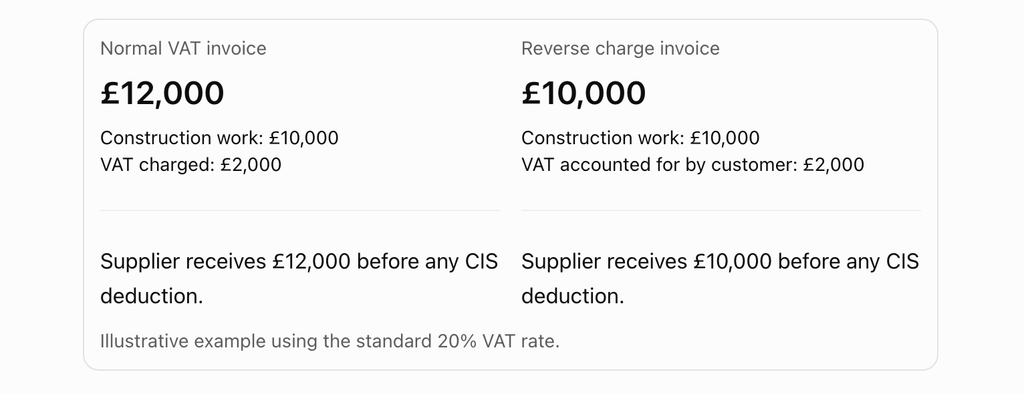
Under normal VAT rules, a VAT-registered supplier charges VAT to the customer and accounts for it to HMRC.
Under the construction VAT reverse charge, the business customer accounts for the VAT instead.
For example, consider a qualifying standard-rated construction service worth £10,000.
The reverse charge generally applies when qualifying standard-rated or reduced-rated construction services are supplied between VAT-registered businesses, payments fall within CIS reporting requirements and no relevant exclusion applies.
It does not normally apply to work carried out directly for private homeowners.
Scaffolding businesses need to be particularly careful. Equipment-only hire, combined hire and labour contracts, and scaffolding supplied for qualifying new-build housing projects can have different VAT treatments.
Our advice: Don’t simply copy the VAT treatment from your previous invoice. Check the nature of the work, the customer and the contract. Incorrect VAT invoices can lead to payment delays, additional tax liabilities and unnecessary disputes.
4. Claim the Business Expenses You’re Entitled To
Construction businesses often incur significant costs, but many owners fail to claim everything they are entitled to.
Depending on your business structure and circumstances, allowable expenses and qualifying tax reliefs may cover:
| Category | Examples |
|---|---|
| Vehicles and travel | Vans, business mileage, fuel, parking and repairs |
| Tools and equipment | Power tools, machinery and scaffolding equipment |
| Materials | Timber, bricks, cement and other construction materials |
| Protective clothing | Safety boots, helmets, gloves and high-visibility clothing |
| Labour | Employee wages and subcontractor costs |
| Insurance | Public liability, employers’ liability and equipment insurance |
| Premises | Workshops, storage yards and offices |
| Professional fees | Qualifying accountancy and legal costs |
| Training | Qualifying business-related training and refresher courses |
| Administration | Business software, phone bills and website costs |
Not everything purchased for work is automatically deductible. Ordinary clothing, personal spending and fines are generally excluded. Mixed business and personal expenses may need to be apportioned, and capital expenditure can be subject to separate tax rules.
Remember that claiming an expense doesn’t mean HMRC pays for it. Spending £1,000 unnecessarily to reduce your tax bill still leaves your business worse off.
Spend money because it benefits your business, not simply because it reduces your tax.
5. Buy or Hire Equipment? Look Beyond the Purchase Price
For construction and scaffolding businesses, equipment represents a significant investment.
Owning machinery or scaffolding equipment can reduce long-term hire costs, but it also ties up capital and creates additional responsibilities for storage, maintenance, inspections and insurance.
Imagine you’re considering purchasing equipment costing £20,000, rather than hiring it when required.
| Annual cost | Owning | Hiring |
|---|---|---|
| Estimated annual depreciation | £4,000 | — |
| Maintenance and inspections | £1,200 | — |
| Storage and insurance | £1,800 | — |
| Hire charges | — | £120 per working day |
| Total annual cost | £7,000 | Depends on usage |
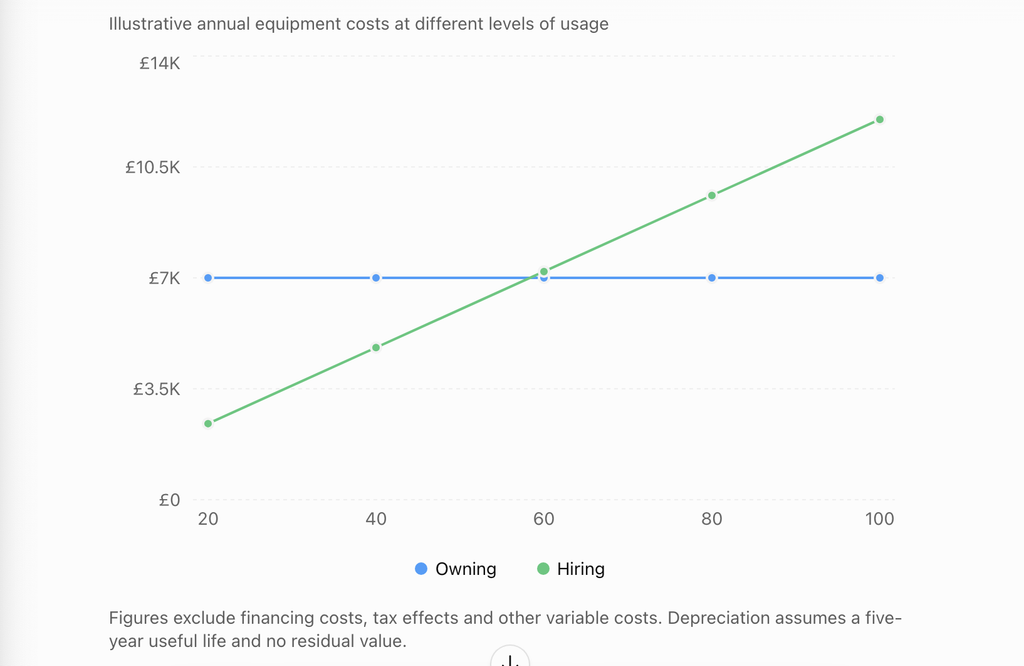
In this simplified example, owning the equipment becomes cheaper at around 59 days of use per year.
There may also be capital allowances available on qualifying equipment purchases, including the Annual Investment Allowance or other applicable reliefs.
However, tax relief should not be the only factor in your decision. Consider how much work you have secured, how frequently the equipment will be used and whether buying it could leave your business short of working capital.
For a growing scaffolding company, every unused scaffold tube sitting in the yard represents money invested but not currently generating income.
Our advice: Calculate your equipment utilisation before expanding your stock. Sometimes hiring additional equipment during busy periods is financially healthier than owning more than you regularly need.

6. Stop Funding Your Customers’ Construction Projects
One of the biggest financial challenges in construction is the gap between paying for work and receiving payment for it.
You may need to purchase materials, pay staff, hire equipment and cover subcontractor costs weeks before your customer pays you.
Imagine you’ve secured a £50,000 construction contract.
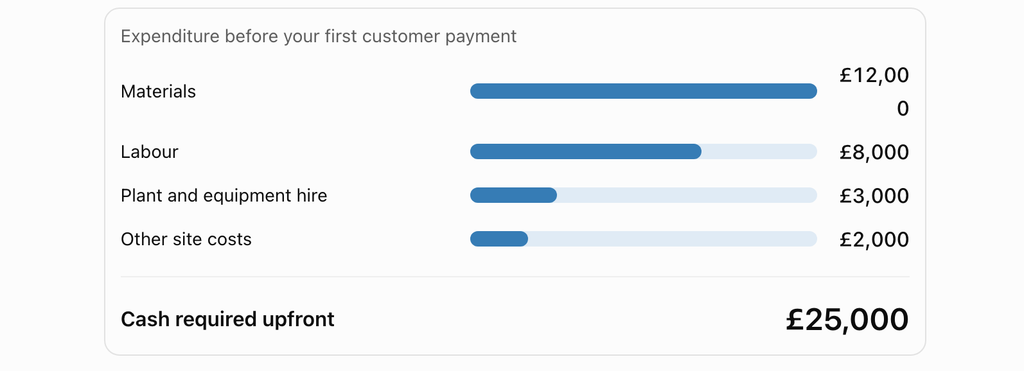
Although the project may eventually generate a healthy profit, you still need £25,000 to fund the work at this stage.
Now imagine running three similar projects at the same time.
Growing too quickly without sufficient working capital can put even a profitable construction company in financial difficulty.
Where appropriate and permitted by your contract, negotiate deposits, staged payments and payments for materials. Invoice promptly, monitor overdue accounts and understand any retention clauses before accepting a contract.
A retention of 5% on a £100,000 contract means £5,000 may remain unpaid until the agreed release conditions are met.
Our advice: Prepare a rolling 13-week cash-flow forecast. It doesn’t need to be complicated. You simply need to know when money is expected to come in, when bills must be paid and whether there’s likely to be a shortfall.
A profitable business can still fail if it runs out of cash.
7. Price Your Jobs to Make a Profit, Not Just to Win Contracts
When competition is tough, it can be tempting to lower your prices to secure contracts and keep your team busy. But winning a job at the wrong price can do more damage to your business than losing it.
One common mistake is calculating the selling price based only on labour and materials, without allowing enough for the cost of running the business.
Imagine you estimate the direct costs of a construction project at £10,000 and add a 20% markup.
Your quotation would be £12,000. However, your margin before overheads would be 16.7%, not 20%.
| 20% markup | 20% margin | |
|---|---|---|
| Direct costs | £10,000 | £10,000 |
| Quoted price | £12,000 | £12,500 |
| Contribution before overheads | £2,000 | £2,500 |
| Margin | 16.7% | 20% |
That’s a £500 difference on just one project. Across 20 similar projects, the difference could amount to £10,000 in annual contribution, assuming costs and sales volumes remain unchanged.
When preparing quotations, remember to account for office administration, insurance, equipment wear, travel, non-chargeable working hours, potential delays and the time you spend managing the project.
Our advice: Review the estimated costs against the actual costs after every major project. If certain types of work consistently deliver disappointing margins, investigate why before accepting more of them.
8. Stop Giving Away Time, Labour and Equipment for Free
In construction, projects rarely go exactly to plan. Customers change their minds, other contractors fall behind schedule and unexpected work needs to be carried out.
The problem is that many construction businesses absorb these extra costs themselves.
For scaffolding companies, this can be particularly expensive. A scaffold might be hired for four weeks but remain on site for eight because another contractor has fallen behind schedule. Meanwhile, your equipment is unavailable for other paying customers.
Your quotation and contract should clearly address:
- The agreed scope of work and hire period.
- Charges for additional hire periods.
- Additional alterations and labour.
- Abortive visits caused by site access problems.
- Transport, dismantling and collection arrangements.
- Responsibilities and charges for inspections where applicable.
Scaffolding safety inspections must be carried out by a competent person at the required intervals, including after installation, at least every seven days during use and after events that could compromise safety. These responsibilities must never be neglected because of commercial disagreements.
Our advice: Agree extra charges in writing before carrying out additional work wherever possible. Clear commercial terms aren’t about being difficult with customers. They’re about protecting the business you’ve worked hard to build.
9. Understand the Real Cost of Growing Your Team
Taking on more workers is often seen as a sign that a construction business is doing well. But before expanding your team, make sure you understand the financial commitment.
An employee’s salary is only part of the cost. You may also need to budget for employer National Insurance, workplace pension contributions, paid holidays, training, insurance, protective equipment and non-chargeable time.
Using subcontractors can offer greater flexibility, particularly when workloads fluctuate. However, you cannot simply classify someone as self-employed because it is cheaper or involves less paperwork.
Employment status depends on the actual working arrangements. CIS registration does not automatically establish that someone is self-employed.
Getting this wrong can result in unexpected tax liabilities and employment-related claims.
Before recruiting, consider whether your existing team is being used efficiently. Better scheduling, fewer unnecessary journeys, improved coordination between sites and more accurate materials planning may increase your capacity without increasing your workforce.
Our advice: Calculate how much additional profitable work a new employee or subcontractor needs to generate before making a commitment.
10. Make Paperwork Less Painful With a Simple Financial Routine
You didn’t start a construction business because you enjoy bookkeeping. We understand that.
But leaving everything until your accountant asks for your records can make running your business unnecessarily stressful. It also means you could be making important decisions based on financial information that is months out of date.
You don’t need to spend hours doing paperwork. Start with a simple routine.
| When | What to do |
|---|---|
| Daily | Photograph receipts and record site-related expenses. |
| Weekly | Send invoices, chase overdue payments and review upcoming bills. |
| Monthly | Check job profitability, CIS deductions, VAT obligations and cash flow. |
| Quarterly | Review tax forecasts, equipment expenditure and business performance. |
| Annually | Review your business structure, tax reliefs and growth plans. |
Using cloud accounting software can make much of this easier. Bank transactions can be imported automatically, receipts can be uploaded from your phone and invoices can be issued without returning to the office.
The aim is not to turn you into an accountant. It is to give you enough financial information to make better business decisions.
Don’t Forget Making Tax Digital for Income Tax
If you operate as a sole trader in the construction industry, Making Tax Digital (MTD) for Income Tax may affect you.
| Qualifying annual income | Mandatory start date |
|---|---|
| Over £50,000 | 6 April 2026 |
| Over £30,000 | 6 April 2027 |
| Over £20,000 | 6 April 2028 |
Qualifying income broadly means gross self-employment and property income before expenses, based on the relevant previous tax return.
Businesses within the rules must keep digital financial records and submit quarterly updates using compatible software. These thresholds do not apply to limited companies, although separate Making Tax Digital requirements apply to VAT-registered businesses.
If you’re still keeping receipts in your van or relying on spreadsheets and paper records, now is a good time to review your bookkeeping arrangements.
Frequently Asked Questions About Construction Business Tax
Can I claim a new van against my construction business tax?
A van purchased for business use may qualify for tax relief. The treatment depends on your business structure, accounting method, finance arrangement and any private use.
Can I claim tax relief on scaffolding equipment?
Qualifying scaffolding equipment may be eligible for capital allowances, including the Annual Investment Allowance, which currently has a £1 million limit. Different rules apply to sole traders using cash basis accounting, who can generally deduct qualifying equipment expenditure directly instead.
Do I need to register for VAT if I already work under CIS?
CIS and VAT are separate obligations. CIS registration does not automatically mean you are VAT registered. You must monitor your taxable turnover against the £90,000 VAT registration threshold, including qualifying sales subject to the domestic reverse charge.
Can I get a CIS tax refund?
If your CIS deductions exceed your actual tax liabilities, you may be entitled to a repayment or an offset against relevant liabilities. The process differs between sole traders and limited companies.
Keeping accurate deduction statements and claiming legitimate business expenses can help ensure you receive the correct amount.
Does a small construction company need an accountant?
There is generally no requirement to appoint an accountant simply because you run a small construction business. However, professional support can be particularly valuable when dealing with CIS, VAT reverse charges, payroll, equipment purchases and tax planning.
A good accountant should do more than submit your tax return. They should help you understand where your money is going, identify opportunities to save tax legally and support your business decisions throughout the year.
Build a Business That Works for You
Starting a construction business takes courage. Growing one takes commitment, long hours and plenty of difficult decisions.
We believe that all that hard work should translate into something more than a full diary. It should give you financial security, a reasonable return for your efforts and the confidence to plan for the future.
You don’t need to understand every tax regulation or become an expert in bookkeeping to run a successful construction business. But you do need reliable financial information and the right support.
At Jermyn & Co Chartered Accountants, we understand the financial challenges faced by construction businesses, builders, building contractors, scaffolding companies and subcontractors.
From business start-ups and CIS returns to VAT, tax planning, bookkeeping, payroll and cash-flow management, we can help you take control of your finances while you focus on what you do best.
Whether you’re laying the foundations of a new business or looking to make your existing construction company more profitable, get in touch with Jermyn & Co. We’re here to help you build a stronger financial future.
This article provides general guidance as at November 2026. All financial examples are illustrative. Tax treatment depends on individual business circumstances.