
Small Business Growth Series #3: Tradespeople
Practical ways for electricians, plumbers, builders, decorators and other tradespeople to increase profit without working longer hours.
Being fully booked doesn’t always mean making good money.
Many tradespeople spend their days rushing between jobs, collecting materials, preparing quotes and dealing with customers. Yet, after expenses, the profit can be surprisingly small.
The answer isn’t necessarily to find more customers or put your prices up.
Sometimes, the biggest opportunity is making better money from the work you’re already doing.
Here are eight practical ideas worth trying.
1. Stop Giving Away Your Smallest Jobs
A customer asks you to replace a tap. While you’re there, they ask you to adjust a cupboard door, check a leaking pipe and fix a loose fitting.
You agree because each task only takes a few minutes.
But those minutes add up.
Try this: Include a clearly defined scope in your quote. Offer a fixed-price package for additional small repairs completed during the same visit.
Customers appreciate knowing the cost upfront, and you get paid for the extra work.
2. Turn One Visit Into Three Jobs
You’re already at a customer’s property. Your tools are out, and you’ve paid the cost of travelling there.
Why not make the visit more productive?
An electrician fitting a new consumer unit could offer a separate quote for additional sockets or outdoor lighting.
A plumber replacing a boiler could offer a heating system health check.
A decorator painting a room could quote for skirting boards or another room.
The trick is to identify genuinely useful additional work, not pressure customers into unnecessary services.
Offering a small menu of optional extras with clear prices makes decisions easier.
3. Sell Convenience, Not Just Your Time
Customers aren’t always looking for the cheapest tradesperson. Often, they’re paying for someone who makes their life easier.
Consider offering:
- A premium appointment with a defined arrival window.
- A complete supply-and-install package.
- Removal and disposal of old fittings.
- A post-installation maintenance visit.
These services can justify additional charges when customers understand the value.
Just make sure the extra revenue covers your costs and leaves a worthwhile margin.

4. Make Every Trip to the Merchant Count
A £15 fitting might seem insignificant.
But collecting it could cost you an hour of travel, fuel and lost working time.
Here’s an example:
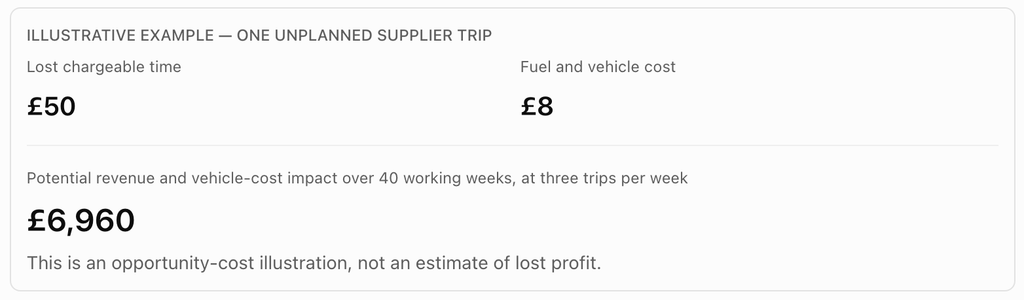
Try this: Prepare materials lists the day before, group supplier collections and keep frequently used fittings in your van.
Saving time can be just as valuable as winning another job.
5. Make Your Quotes Work Harder
Most tradespeople send a quote and wait for an answer.
But a quote can do more than simply state a price.
Consider offering three options:
| Option | Example |
|---|---|
| Essential | Complete the requested work |
| Enhanced | Work plus a useful upgrade |
| Complete | Work, upgrade and aftercare |
For example, a bathroom fitter might offer standard installation, installation with upgraded fittings, or a complete package including accessories.
This gives customers choice without making them feel pressured.
It can also increase the value of jobs you’ve already won.
6. Turn Finished Jobs Into Future Income
A completed job shouldn’t always mean the end of the customer relationship.
Some trades are particularly well suited to repeat services.
An electrician could offer periodic inspections where appropriate. A heating engineer could offer annual servicing. A gardener could offer seasonal maintenance.
With the customer’s permission, send reminders when relevant work becomes due.
The benefit: You spend less time finding new customers and more time serving people who already trust you.
Any maintenance or inspection offer should reflect the relevant legal and safety requirements.

7. Find Out Which Jobs Actually Pay Best
A £2,000 job isn’t necessarily better than a £600 job.
Imagine:
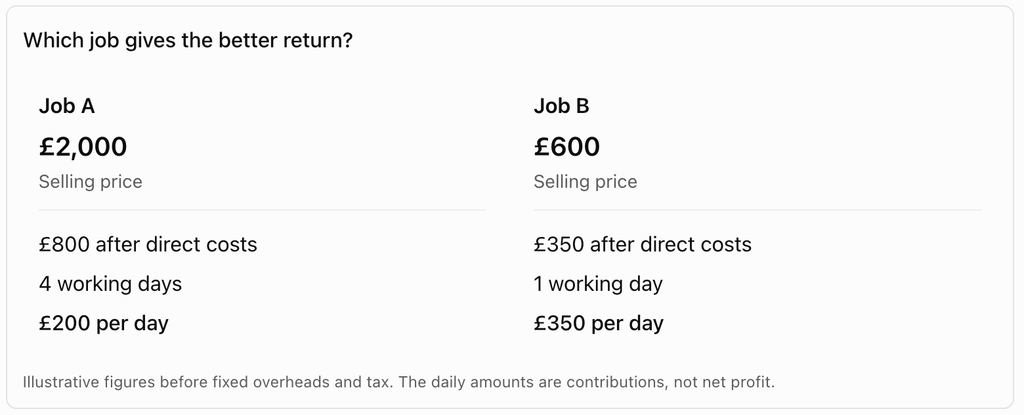
Job B produces a higher contribution per working day.
This doesn’t mean you should stop taking larger jobs. It means you should understand which work gives you the best return.
Track actual hours, materials, subcontractors and other direct costs against your original quote.
You may discover that certain jobs are far more worthwhile than others.
8. Charge for Changes Before They Become Arguments
Customers change their minds. That’s normal.
A customer might choose different tiles, request additional sockets or ask for another wall to be painted.
The problem starts when extra work is agreed verbally but never properly priced.
Try this: Use a simple variation process.
Before carrying out additional work, confirm the new scope, price and any change to the completion date in writing.
A short email or message can prevent misunderstandings and protect your margin.
For larger projects, make sure this process is consistent with your contract.
The Bottom Line: Work Smarter, Not Necessarily Longer
More jobs don’t always mean more profit.
Sometimes, the best opportunities come from reducing wasted time, charging properly for additional work and making better use of existing customer relationships.
The most important question isn’t simply “How much did I invoice this month?”
It’s “How much money did I actually make from the time and effort I put in?”
At Jermyn & Co, we help small business owners understand the numbers behind their work. From job profitability and cash flow to managing costs, good accounting can support better business decisions.
Want to understand where your business is making money — and where it’s losing it? Get in touch today.