
Introduction
The Chancellor of the Exchequer, John Healey, presented his first Budget to Parliament on Wednesday 28 October 2026. It is the first Budget under Prime Minister Andy Burnham’s government.
The government’s central message was “breathing space”: helping households and businesses cope with higher energy prices while keeping public borrowing on a downward path. It kept its promise not to raise the headline rates of income tax, National Insurance contributions or VAT. Instead, it chose a smaller number of targeted measures to raise money, mainly from savings and property income, banks, and some business reliefs.
Most of the changes do not take effect straight away. Many start on 6 April 2027, the beginning of the next tax year, and some not until 2028 or 2029. That gives individuals and businesses time to understand them and plan.
This guide explains the main announcements in plain terms, grouped by who they affect. It is based on the official documents published by HM Treasury, HM Revenue & Customs (HMRC) and the Office for Budget Responsibility (OBR).
The economy and public finances
The OBR, the independent body that produces the official forecasts, expects the UK economy to grow by 1.2% in 2026 and 1.0% in 2027, before picking up to 1.6% in 2028. The slowdown next year is mainly due to higher energy prices following the conflict in the Middle East and higher interest rates.
Inflation was 3.5% in September 2026. The OBR expects it to peak at 3.8% in the first quarter of 2027 and return to the Bank of England’s 2% target by the third quarter of 2028.
| OBR forecast | 2026 | 2027 | 2028 |
|---|---|---|---|
| Economic growth (GDP) | 1.2% | 1.0% | 1.6% |
| Inflation (CPI) | 3.1% | 3.4% | 2.1% |
| Unemployment rate | 5.0% | 5.1% | 4.9% |
On the public finances, the government says it is meeting its two fiscal rules. Government borrowing is forecast to fall from 4.2% of national income (GDP) in 2026-27 to 1.8% by 2031-32. However, higher global borrowing costs mean the government expects to spend around £14 billion a year more on debt interest than forecast in March.
The government has also announced that a spending review and a further Tax Update will take place in 2027.
Help with household costs
Several measures aim to ease the cost of living, particularly energy bills.
- VAT on electricity: the temporary 0% VAT rate on household electricity in Great Britain is extended to 30 June 2027. The Treasury expects this to take around £50 off the annual Ofgem price cap from April 2027.
- Household Energy Payment: households in England in council tax bands A to D, up to 20 million homes, will receive a one-off £100 payment from January 2027, delivered through the council tax system. The devolved governments receive equivalent funding.
- Extra local support: £100 million for councils in England to help households hit hardest by energy bills, including some in higher council tax bands.
- Fuel duty: the 5p per litre cut is extended to 30 June 2027. From 1 July 2027, fuel duty returns to its pre-2022 level and rises with inflation.
- Gas standing charges: the government has asked Ofgem to abolish gas standing charges on household bills. Details and timing are still to come.
- National Living Wage and National Minimum Wage: rates will rise by 3.9%.
- Food prices: tariffs on over 100 food and drink products will be temporarily reduced.
- Bus fares: the £2 bus fare cap will remain in place over 2027.
To help pay for the energy support, the corporation tax surcharge paid by banks will rise temporarily from 3% to 6% between 1 January 2027 and 31 March 2028.
Income tax, National Insurance and allowances
What stays the same
The headline rates of income tax and National Insurance on earnings are unchanged. Under legislation already in place, the Personal Allowance stays at £12,570 and the higher rate threshold at £50,270 for the 2027-28 tax year.
Most National Insurance limits and thresholds remain at their 2026-27 levels until the 2030-31 tax year, as previously announced. A few small figures rise with inflation for 2027-28:
- the Lower Earnings Limit rises to £6,916 a year (£133 a week);
- the Class 2 Small Profits Threshold rises to £7,355 a year;
- voluntary Class 2 contributions will be £3.80 a week and Class 3 contributions £19.05 a week.
What changes
- Trading Allowance: rises from £1,000 to £3,000 from 6 April 2027. People with small amounts of trading or miscellaneous income below this level will not need to declare it or pay tax on it. The Self Assessment reporting threshold for trading income also rises to £3,000.
- Business mileage: the tax-free rate for using your own vehicle for work above 10,000 miles a year rises from 25p to 35p per mile from 6 April 2027.
- Employment expenses: from April 2028, the £2,500 limit that currently forces some employees into Self Assessment to claim work expenses will be removed. More people will be able to claim through PAYE instead.
- Travel and subsistence rates: simplified benchmark rates for employers reimbursing subsistence will be £20 (over 5 hours), £60 (over 10 hours) and £75 (over 24 hours) from 6 April 2028.
- Visa costs: employers’ payments of certificate of sponsorship fees and the immigration skills charge for Skilled Worker visas will not be taxed as employee income, from 28 October 2026.
Scotland and Wales
Income tax rates on earnings for Scottish taxpayers are set by the Scottish Parliament, and Welsh rates are set by the Senedd. The new property income rates described below can also be set by the Scottish and Welsh governments.
Savings, ISAs and first-time buyers
Higher tax on savings interest
From 6 April 2027, savings income above your tax-free allowances will be taxed at:
| Band | Savings income tax rate from 6 April 2027 |
|---|---|
| Basic rate | 24% |
| Higher rate | 44% |
| Additional rate | 49% |
This follows a 2 percentage point increase announced in the previous Budget, plus a further 2 points announced this year. These rates apply across the UK.
The Personal Savings Allowance and the Starting Rate for Savings remain. The Treasury estimates that a basic rate taxpayer would need more than £25,000 in savings outside an ISA, at an average interest rate of 4%, before paying any tax on savings interest. According to the Treasury, 84% of income tax payers will not be affected by the new savings and property rates.
ISAs
- Cash ISA: the annual limit stays at £20,000. A previously planned cut will not go ahead.
- Stocks and shares ISA: the government will work with the investment industry on a new incentive for first-time investors. No details yet.
- First Time Buyer ISA: from April 2029, this will replace the Lifetime ISA for new savers. It will pay a 25% government bonus on the final balance, up to £20,000, towards a first home worth up to £450,000. Existing Lifetime ISA holders can carry on under the current rules.
- Lifetime ISA withdrawal charge: from 29 October 2026, the charge for using the money to buy a home above the price cap falls from 25% to 20%.
Help for first-time buyers
The government confirmed £4.7 billion for a new “Your First Home” equity loan scheme for first-time buyers, which it says will help 70,000 households.
Pensions, the State Pension and Inheritance Tax
State Pension and the Triple Lock
The government will adjust the State Pension Triple Lock from the next Parliament. It says the State Pension will still rise every year and will track earnings over time. The government estimates the change will reduce State Pension spending by £15 billion a year by the late 2030s. Alongside this, it plans a National Care Service in England with personal care free at the point of use. Full details have not yet been published.
Pension Tax Allowance
From 6 April 2027, a new Pension Tax Allowance means pensioners whose total income is no more than the full new State Pension will not have to pay small amounts of income tax as a result of State Pension increases. It applies for the 2027-28, 2028-29 and 2029-30 tax years.
Pensions and Inheritance Tax
As already legislated, most unused pension funds and pension death benefits will be included in the value of an estate for Inheritance Tax from 6 April 2027. This Budget adds practical changes, including allowing personal representatives to ask pension schemes to pay the Inheritance Tax due directly to HMRC.
Other pension changes
- The “two-year rule”, which could make tax-free death benefits taxable if paid late, is removed for payments from 28 October 2026.
- Serious ill-health lump sums will be available where a member is expected to live for less than a year, and medical evidence from a doctor outside the UK will be accepted in some cases.
- Defined benefit schemes will be able to pay surplus funds directly to members from 6 April 2027, taxed as pension income.
Inheritance Tax and trusts
New rules restrict deductions for certain liabilities when valuing trust property for Inheritance Tax, for deaths and other chargeable events from 28 October 2026.
Landlords and property owners
New property income tax rates
From 6 April 2027, rental profits and other property income will be taxed at their own rates in England, Wales and Northern Ireland:
| Band | Property income tax rate from 6 April 2027 |
|---|---|
| Basic rate | 24% |
| Higher rate | 44% |
| Additional rate | 49% |
The Scottish and Welsh governments have the power to set their own property income rates.
HMRC is also consulting on asking third parties to report more property income data to HMRC.
High Value Council Tax Surcharge
From April 2028, an additional charge will apply to residential properties worth £2 million or more. This was announced in the previous Budget and will now be legislated.
Selling property
From 28 October 2026, late filing penalties for a UK property disposal return will stop building up once the sale is reported on the owner’s Self Assessment tax return.
Companies holding residential property
The Annual Tax on Enveloped Dwellings charges will rise by 3.5% from 1 April 2027.
Small businesses, the self-employed and employers
Business rates for high street businesses
From April 2027, retail, hospitality and leisure businesses in England will see their business rates frozen in real terms, reduced, or cut to zero:
- pubs, music venues and social clubs receive an extra 20% reduction;
- the Small Business Rate Relief threshold rises, so a further 70,000 retail, hospitality and leisure businesses will pay no business rates at all;
- rates for all other retail, hospitality and leisure properties are frozen for two years.
VAT changes
- Online marketplaces: from October 2027, platforms will collect VAT on behalf of UK businesses selling more than £90,000 a year through that platform. Personal sales, second-hand goods and business-to-business sales are not affected.
- Services bought from overseas: from April 2027, the “reverse charge” will apply only if the UK customer is VAT registered. Overseas suppliers selling to unregistered UK businesses will need to charge UK VAT.
- Electric vehicle charging: electricity from public charging points is confirmed as standard rated for VAT from 1 November 2026.
- Private hire: larger taxi and private hire operators will charge VAT on the full fare from 2 January 2028. A turnover threshold of £50 million is the leading option.
Employers
- Benefits in kind through payroll: employers must report and tax benefits in kind through payroll. This starts with company cars, vans, fuel and private medical benefits from 6 April 2027, and covers most other benefits from 6 April 2028. Employment-related loans and living accommodation are excluded.
- Company car tax: rates rise by 1 percentage point in 2030-31, to a maximum of 40%.
- Van and fuel benefits: the van benefit charge and the car and van fuel benefit charges will rise in line with September 2026 CPI inflation from 6 April 2027.
- Parental pay: parental pay will be expanded, including to self-employed fathers and partners for the first time.
The self-employed
The higher Trading Allowance of £3,000 and the higher mileage rate described above also apply to sole traders. Changes to Making Tax Digital and Payments on Account are explained in the section on reporting and paying tax.
Business owners and investors
Selling a business: Business Asset Disposal Relief
Business Asset Disposal Relief lets qualifying business owners pay a lower rate of Capital Gains Tax when they sell all or part of their business. The lifetime limit on gains that can qualify will fall from £1 million to £500,000 for disposals on or after 6 April 2027.
Special rules apply where a contract was entered into before 6 April 2027 but completes afterwards, and for some share reorganisations. The government says three-quarters of people who claim the relief will still receive it on their whole gain.
A new Founders’ Relief
A new Capital Gains Tax Founders’ Relief will offer a lower rate on qualifying disposals by founders and early investors who have made a significant long-term contribution to high-growth companies. It is intended to apply from 6 April 2027. A technical consultation on how it will work closes on 30 November 2026.
Capital allowances
| Allowance | Change | From |
|---|---|---|
| Main rate first-year allowance | Rises from 40% to 50% | Spending from 1 January 2027 |
| Main rate writing-down allowance | Falls to 12% | 1 April 2027 (companies), 6 April 2027 (unincorporated businesses) |
| Full expensing for companies | Maintained | — |
Corporation Tax
The main rate stays at 25% and the small profits rate at 19% for the financial year starting 1 April 2028. The government is keeping to its 2024 Corporate Tax Roadmap and has launched a consultation on simplifying parts of the corporate tax system.
Taking money out of a company
The government will modernise how distributions from companies to individual shareholders are taxed, from April 2028. It says the aim is to stop well-advised taxpayers structuring profit extraction to get more favourable treatment, while protecting genuine changes of ownership, including family business successions. Draft legislation will be published in 2027.
Employee share schemes and investment schemes
- The Company Share Option Plan (CSOP) limit rises to £120,000 per employee from 6 April 2027, and its exercise period extends to 15 years.
- After an event that disqualifies Enterprise Management Incentive (EMI) options, employees will have 180 days to exercise.
- From 6 April 2027, companies will no longer need to notify HMRC separately of each EMI option grant; it will go in the end-of-year return.
- Minor technical fixes are made to SEIS, EIS and Venture Capital Trusts.
Research and development
The Claim Notification Form for R&D tax relief claims will be removed for claims made on or after 1 April 2027.
How you report and pay tax
Several changes will alter how tax is reported and paid over the next few years.
- Making Tax Digital for Income Tax: people who must join in April 2027 will not receive late submission penalty points for quarterly updates in the 2027-28 tax year. They will still need to send the updates before filing their tax return. Some groups, including those claiming qualifying care relief, are exempt until further notice.
- Payments on Account: from April 2029, Self Assessment taxpayers who make Payments on Account will instead make smaller, more regular automated payments during the year. They will be able to choose to pay through PAYE.
- Direct Debit for VAT and PAYE: from April 2029, businesses will need to set up a Direct Debit for VAT and PAYE return liabilities, with some exceptions.
- VAT e-invoicing: VAT invoices will need to be issued and received electronically in a set format from April 2029. A consultation on digital reporting runs until 20 January 2027.
- Correcting mistakes: from 1 April 2028, taxpayers will have a general duty to correct inaccurate tax returns once they spot an error. HMRC will be able to issue a “Customer Correction Notice” where it suspects an inaccuracy.
- Company tax returns: amended company tax returns must be filed online from 1 April 2028.
- Unpaid tax debts: HMRC will be able to recover smaller tax debts directly from the bank accounts of people who can pay but repeatedly fail to engage, expected from 2029-30.
- HMRC staffing: an additional 670 compliance officers, on top of 5,500 already planned, by 2029-30.
One proposal will not go ahead for now: new reporting requirements for payments made by companies to their participators will not be introduced at this time.
Key dates at a glance
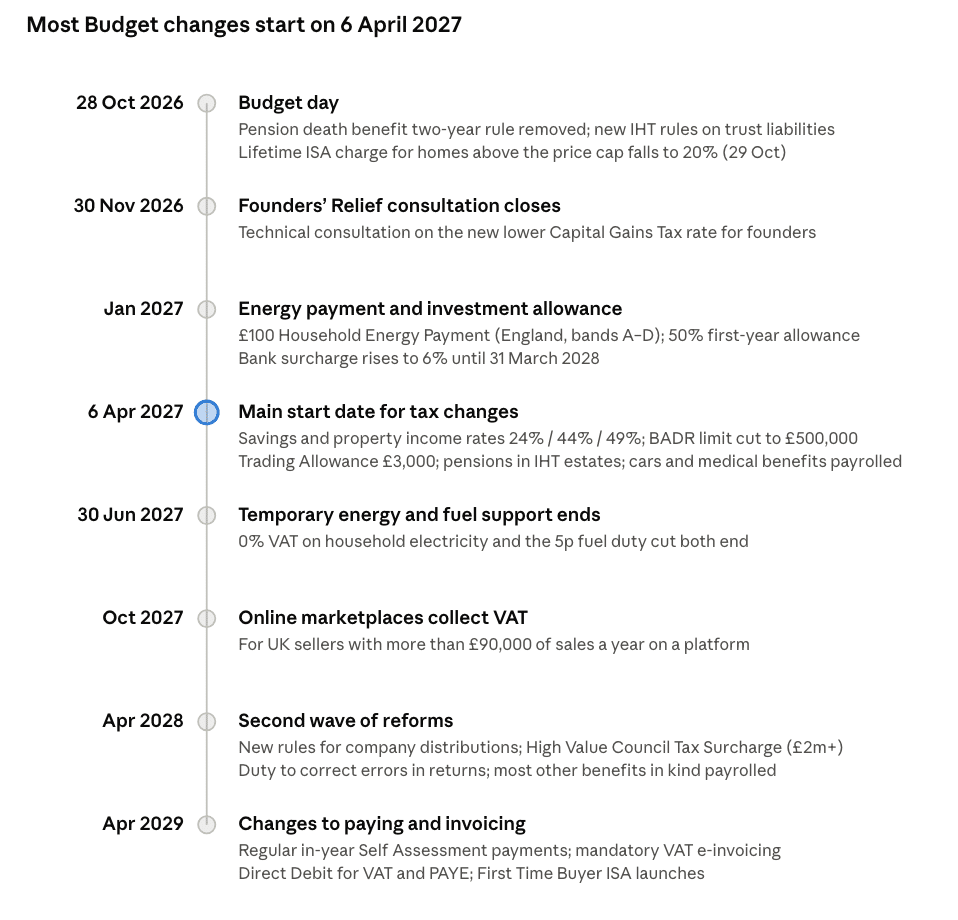
The busiest date is 6 April 2027, the start of the 2027-28 tax year, when most of the personal and business tax changes take effect.
Frequently asked questions
1. Will my income tax go up?
The rates of income tax on earnings are not changing. However, if you have savings interest or rental income above your allowances, you will pay more tax on that income from 6 April 2027.
2. Is the cash ISA allowance being cut?
No. It stays at £20,000 a year.
3. Has anything changed for National Insurance?
The main rates are unchanged and most thresholds stay frozen until 2030-31. A few minor figures, such as the Lower Earnings Limit and voluntary contribution rates, rise with inflation in 2027-28.
4. I am thinking of selling my business. What has changed?
The lifetime limit for Business Asset Disposal Relief falls from £1 million to £500,000 for disposals from 6 April 2027. Transitional rules apply to some contracts signed before that date.
5. Do I need to do anything about Making Tax Digital?
If you are required to join Making Tax Digital for Income Tax from April 2027, you must still send quarterly updates. You will not receive late submission penalty points for these updates during 2027-28.
6. Are these changes final?
Most will be included in the Finance Bill 2026-27, which must be approved by Parliament. Some details are still subject to consultation and may change.
How we can help
Most of these changes start from April 2027 or later, which leaves time to prepare. If you would like to understand how the Budget affects you, your family or your business, please contact the Jermyn & Co team.
Important information: this article is a general summary of announcements made at Budget 2026 on 28 October 2026. It does not constitute tax, legal or financial advice, and it should not be relied on for any decision about your own circumstances. Budget measures may change before they become law. Information correct as at 29 October 2026.